If you are thinking about buying an investment property in Stark County, you are probably asking a practical question first: will the numbers hold up over time? That is the right place to start. Stark County offers real opportunity for single-family rentals and small multi-family properties, but it is a market where discipline matters more than guesswork. In this guide, you will learn how to read the local housing mix, compare rent signals, spot common risks in older homes, and build a smarter buy-and-hold plan. Let’s dive in.
Why Stark County Draws Investors
Stark County is a sizable, established housing market with 373,771 residents and 168,848 housing units. The homeownership rate is 69.2%, median household income is $67,934, and median gross rent is $909. Those numbers point to a market with both owner-occupied demand and a meaningful rental base.
For investors, this tends to support steady income-focused strategies more than speculation. The county also had 643 building permits in 2025, which suggests new supply exists but does not overwhelm the existing housing stock. If your goal is long-term cash flow and measured value growth, Stark County can deserve a close look.
Where Single-Family Fits Best
Single-family rentals are the broadest acquisition category in Stark County. County planning data shows that 75% of residential units are 1-unit detached homes, which means you will usually see the most options in this part of the market.
That matters because a larger inventory gives you more room to compare condition, price, and likely rent. It also means you can be selective instead of forcing a deal. In many cases, the better single-family opportunity is not the cheapest house, but the one with the strongest balance of condition and rent potential.
Why inventory type matters
When most of the housing stock is detached housing, renter demand often spreads across many neighborhoods and price points. That can help you find properties that match common renter preferences for space, storage, and privacy.
At the same time, not every house will perform the same way. Bedroom count, layout, age, and repair needs can affect your returns just as much as the purchase price.
Why Small Multi-Family Still Matters
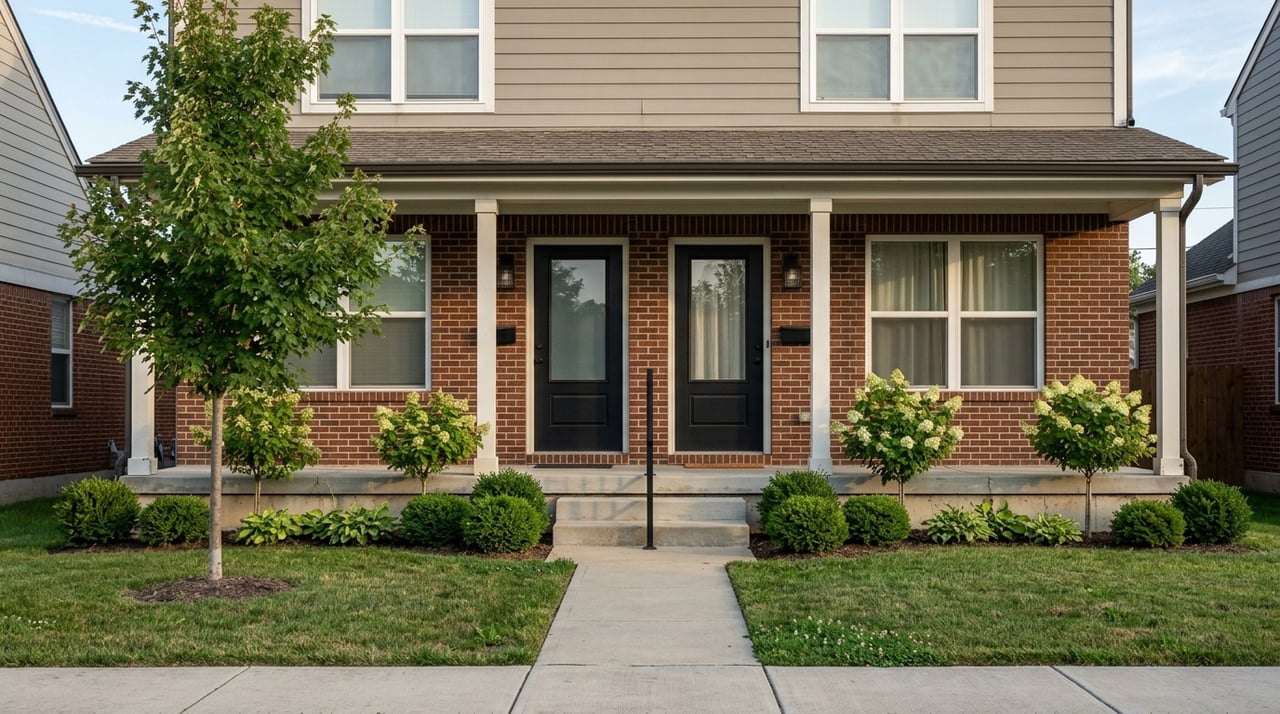
Even though single-family dominates the county’s housing mix, small multi-family is still a real part of the market. About 10% of residential units are in 2-to-4-unit properties, which keeps duplexes, triplexes, and fourplexes in play for investors who want more than one income stream under one roof.
This can be appealing if you want to spread vacancy risk across multiple units. If one unit turns over, the entire property is not sitting empty. That said, small multi-family properties also require more attention to shared systems, utility setup, and repair planning.
What to look for in duplexes and fourplexes
In small multi-family, the unit mix matters. A property with practical bedroom counts and a layout that supports efficient turnover may underwrite better than one with awkward floor plans or heavy utility burden.
You should also pay close attention to whether rents can support the full picture, including vacancy, turnover, and utilities. A property can look attractive on gross rent alone and still underperform once expenses are added back in.
Understand Stark County Rent Signals
One of the biggest mistakes investors make is relying on a single rent number. In Stark County, different rent datasets measure different things, so they should be used together instead of treated as direct matches.
Census QuickFacts lists median gross rent at $909. Zillow’s county rental index shows an average asking rent of $1,091. HUD’s FY2026 2-bedroom fair market rent for the Canton-Massillon MSA is $1,086, and HUD defines that as gross rent including tenant-paid utilities at the 40th percentile of standard-quality rental units.
Use rent ranges, not one average
Rent ranges are often more useful than countywide averages. Rentometer data suggests these typical asking-rent bands in Stark County:
- 1BR apartments: about $725 to $1,100
- 2BR apartments: about $885 to $1,300
- 3BR apartments: about $1,090 to $1,500
- 1BR houses: about $650 to $950
- 3BR houses: about $1,095 to $1,495
- 4+BR houses: about $1,250 to $1,650
These ranges help show how much property type, size, and condition can influence performance. A clean three-bedroom house and an older one-bedroom apartment should not be underwritten with the same expectations.
City-level comps matter
County averages only get you so far. Zillow shows average asking rents of $999 in Canton and $1,050 in Massillon, with additional variation by bedroom count.
In Canton, average asking rents are $750 for 1-bedroom units, $959 for 2-bedroom units, $1,275 for 3-bedroom units, and $1,310 for 4-bedroom units. In Massillon, the averages are $795, $1,000, $1,295, and $1,343. Those differences reinforce a simple rule: underwrite using local comps, not just countywide headlines.
Home Values Vary Across Stark County
Price dispersion is another reason to stay local in your analysis. Zillow reports current typical home values of $175,908 in Canton and $220,454 in Massillon, while countywide average home value is $219,738.
That spread can affect both your entry cost and your rent-to-price relationship. A lower purchase price does not automatically create a better investment if the repair burden is high or the achievable rent is soft. On the other hand, a somewhat higher-priced property may still be a stronger hold if condition, demand, and maintenance needs are better.
Older Housing Requires Better Due Diligence
Stark County’s housing stock is not new. County profile data reports a median year built of 1964, with a substantial share of homes built before 1940.
For you as an investor, that means inspection quality and reserve planning are especially important. Older homes can offer solid long-term value, but they often come with more risk around major systems and deferred maintenance.
A smart inspection checklist
Before you buy, pay close attention to:
- Roof condition
- HVAC age and function
- Plumbing materials and leaks
- Electrical service and panel condition
- Foundation and drainage issues
- Utility separation in multi-family properties
- Signs of deferred maintenance
In a duplex or fourplex, one repair issue can affect multiple tenants at once. That can increase both cost and disruption, which is why strong due diligence matters so much in this market.
Use County Tools During Underwriting
The Stark County Auditor’s real estate search is one of the most useful starting points for parcel-level review. It provides access to search tools, GIS and map search, septic and well search, values, value history, sales, tax summary, tax detail, tax distribution, special assessments, a tax estimator, and separate residential and commercial tabs.
That can help you build a more complete picture before you make an offer. The Treasurer’s office directs users back to the Auditor for current tax payment information, and the Auditor notes that the site is for reference only, with original recorded documents governing legal transactions.
Market Speed Favors Prepared Buyers
Current market signals suggest that quality properties can move quickly. Zillow shows 871 properties for sale in the county and 7 days to pending, while Redfin reports a median sale price of $237,288 for the three months ending May 2026 and median days on market of 15.
For investors, that means you should be ready before the right property appears. Have your financing lined up, your buy box defined, and your repair assumptions ready. In a faster-moving market, hesitation can cost you a good opportunity, but rushing into weak numbers can cost you even more.
Best Strategy for Stark County Rentals
For many buyers, the most defensible approach in Stark County is a conservative buy-and-hold or light value-add plan. The local data points to a market that supports disciplined income investing more than speculative appreciation.
That usually means focusing on a few basics:
- Buy where the rent-to-price relationship makes sense
- Let neighborhood and city-level comps guide rent expectations
- Keep leverage moderate
- Carry realistic repair reserves
- Budget for vacancy and turnover
- Avoid stretching rent assumptions to justify the purchase
This is especially important in a county with older housing stock and meaningful variation between submarkets. A steady property in decent condition can be a stronger long-term asset than a bargain purchase with hidden repair exposure.
Management Can Shape Your Returns
As your door count rises, day-to-day operations matter more. Rental management tasks like pricing, listing, applications, leases, payments, maintenance coordination, tenant communication, and renewals all influence the actual return you keep.
If you live outside the area or want a more hands-off experience, professional management may reduce friction. Even with a small portfolio, the quality of management can affect vacancy, maintenance costs, and tenant retention.
Final Thoughts on Investing in Stark County
Stark County can make sense for investors who want practical, income-oriented opportunities in single-family homes and small multi-family properties. The opportunity is real, but the best results usually come from careful underwriting, local rent analysis, and disciplined due diligence.
If you are exploring investment property in Stark County or comparing submarkets across Northeast Ohio, working with someone who understands local pricing, property condition, and neighborhood-level differences can help you make a more confident decision. To talk through your goals, connect with Amy Marinello.
FAQs
What types of investment properties are most common in Stark County?
- Single-family homes are the most common, with 75% of residential units classified as 1-unit detached properties, while 2-to-4-unit properties make up about 10% of the housing stock.
What is a useful rent benchmark for Stark County investment property?
- A useful starting point is to compare Census median gross rent of $909, Zillow average asking rent of $1,091, and HUD’s FY2026 2-bedroom fair market rent of $1,086, then refine your estimate using neighborhood and property-specific comps.
What should you watch for when buying older rental property in Stark County?
- You should look closely at roofs, HVAC, plumbing, electrical, foundation or drainage issues, utility separation in multi-family properties, and signs of deferred maintenance because the county’s housing stock is older overall.
What makes small multi-family property different in Stark County?
- Small multi-family properties can reduce vacancy risk by creating multiple income streams, but they also require careful review of shared systems, utilities, repair exposure, and whether the unit mix supports achievable rents.
What county resource can help with Stark County property research?
- The Stark County Auditor’s real estate search can help you review parcel-level information such as sales history, values, taxes, special assessments, GIS mapping, and related property details.